
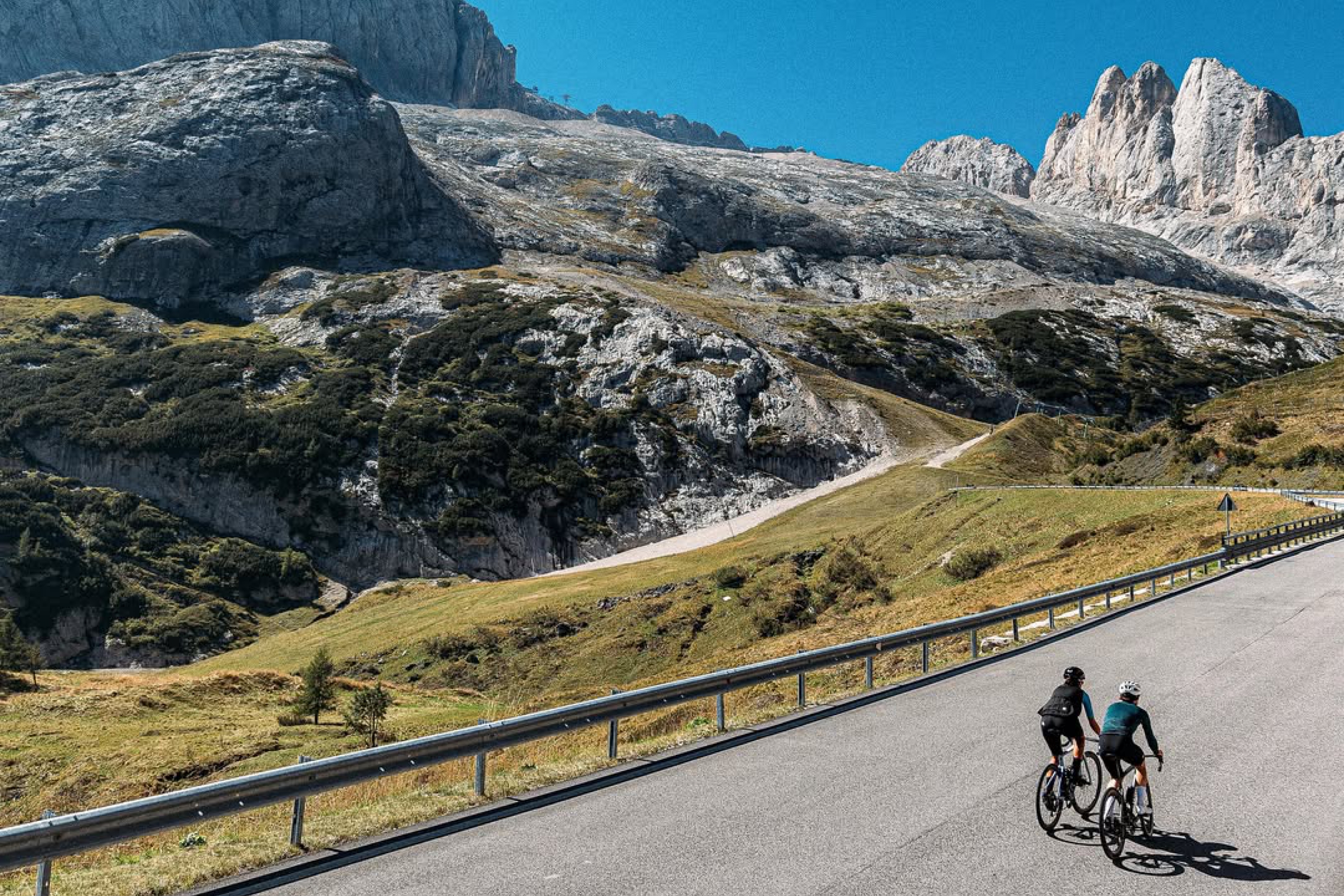
Cycling in the Dolomites: Routes, Passes and Everything You Need to Know
11.04 - 31.05.26
Few places on earth test and reward a cyclist the way the Dolomites do. The climbs are long, the passes legendary, and the views — the sharp pink rock towers, the green valleys, the silence between peaks — are unlike anything else in Europe. For serious cyclists, the Dolomites are not simply a destination. They are a benchmark.
This guide covers the routes that matter, when to ride them, and what to expect on the road.
Why the Dolomites Are a Bucket-List Cycling Destination
The Dolomites are a UNESCO World Heritage Site — and the roads that wind through them are among the most technically and scenically extraordinary in the world. Cyclists have been drawn here for over a century, drawn by the same passes that have decided Grand Tour stages at the Giro d'Italia: Passo Giau, Passo Falzarego, Passo dello Stelvio, Tre Cime di Lavaredo.
What makes cycling in the Dolomites genuinely different from other mountain destinations:
- The scale of the passes — long, sustained climbs with gradients that demand respect
- The visual drama — the Dolomite rock formations are unlike any other mountain range in Europe
- The cultural depth — South Tyrolean villages, Ladin traditions, alpine huts with extraordinary food
- The road quality — many of the classic passes are closed to heavy traffic, making them a rare pleasure on two wheels
The Essential Cycling Routes in the Dolomites
Sella Ronda — The Iconic Loop
The Sella Ronda is the defining Dolomites cycling circuit. A 55 km loop around the Sella massif, it crosses four mountain passes — Passo Gardena, Passo Campolongo, Passo Pordoi and Passo Sella — and can be ridden in either direction. The total elevation gain is around 1,700 metres.
It is not the hardest ride in the Dolomites, but it is the most complete: four distinct passes, four different valley descents, and views in every direction of the most recognisable peaks in the range.
- Best base: Corvara (Alta Badia) or Selva di Val Gardena
- Distance: ~55 km
- Elevation gain: ~1,700 m
- Difficulty: Challenging — suitable for experienced road cyclists
Passo Giau — The Photographer's Climb
Passo Giau (2,236 m) is one of the most beautiful climbs in the Alps. The road rises through open alpine meadows above the treeline, with the Dolomite towers of the Croda da Lago and Ra Gusela rising behind you as you climb. The view from the top is frequently used as a symbol of the Dolomites themselves.
It appeared in the 2011 and 2016 Giro d'Italia and has become a pilgrimage for road cyclists worldwide.
- Start: Colle Santa Lucia or Cortina d'Ampezzo
- Length: ~9 km from Colle Santa Lucia
- Average gradient: ~9.3%
- Difficulty: Very hard
Passo Falzarego — History and Altitude
At 2,105 metres, Passo Falzarego connects the Ampezzo Valley with Alta Badia and offers one of the most historically charged landscapes in the Dolomites — the surrounding peaks were the scene of intense fighting during the First World War. The climb from Cortina is long and consistent, with sweeping views opening up on the final kilometres.
Combining Falzarego with the ascent to Passo Valparola makes for one of the great half-day rides in the Dolomites.
- Start: Cortina d'Ampezzo
- Length: ~16 km
- Average gradient: ~5.5%
- Difficulty: Hard
Tre Cime di Lavaredo — The Climb to the Icon
The road to Tre Cime di Lavaredo is not long, but it is steep — and it leads to the most iconic viewpoint in the Dolomites. The three vertical towers, rising sharply above the plateau, are the symbol of the entire range. Riding to them rather than walking is a privilege that makes the effort worthwhile.
- Access: From Misurina
- Length: ~7 km (with sections above 12%)
- Difficulty: Very hard
Maratona dles Dolomites — The Grand Event
The Maratona dles Dolomites is one of the most prestigious amateur cycling events in the world. Held each July, it offers participants the choice of three courses — the Medio (55 km), the Gran (106 km), and the Maratona (138 km, nine passes) — all routed through the most spectacular roads in the Dolomites.
Places are allocated by ballot and highly sought-after. For those who want to experience the Maratona with full logistical support — transfers, accommodation, mechanical assistance, nutrition — Bike Tour Evolution offers a dedicated guided experience built around the event.
When Is the Best Time to Cycle in the Dolomites?
The Dolomites cycling season runs from late May to early October. Outside this window, many passes are closed by snow.
June is ideal for the high passes: the snow has cleared, the roads are open, and the meadows are at their most vivid green. Traffic is lighter than in summer.
July and August bring the best weather but also the most tourists. Popular passes can be busy on weekends. Early morning starts solve most of this.
September is the finest month for experienced cyclists. The light is extraordinary, temperatures are cooler for climbing, and the roads are quieter. The colours of autumn begin in the forests below the passes.
Road Bike or E-Bike in the Dolomites?
The Dolomites are serious terrain. The passes are long and the gradients are real.
Road cycling in the Dolomites is best suited to cyclists with a solid base of fitness and some mountain experience. The rewards are proportional to the effort — but the effort is significant.
E-bike tours have opened the Dolomites to a much wider range of cyclists, and this is entirely legitimate. The landscape is the reason to be here, and an e-bike allows you to experience the passes, the views, and the altitude without the suffering being the main event. For those combining cycling with culture, relaxation and alpine hospitality, an e-bike Dolomites tour is often the better choice.
Cycling the Dolomites with a Private Guide
The Dolomites reward local knowledge. The best roads are not always the most obvious ones. The difference between a route that is merely hard and one that is hard and beautiful comes down to knowing which passes to combine, which valleys to descend, and where to stop.
At Bike Tour Evolution — based in the Dolomites — every tour is designed around this knowledge. Routes are built around your level and your goals. Support is complete: transfers, mechanical assistance, nutrition, and accommodation in carefully selected alpine hotels.
For those seeking something exceptional, select departures include riding with Daniele Bennati, former Grand Tour stage winner and Italian national cycling coach — a perspective on these roads that no guidebook can provide.
Practical Information for Your Dolomites Cycling Tour
- Where to base yourself: Corvara (Alta Badia) gives the best access to the Sella Ronda circuit. Cortina d'Ampezzo is the gateway to Passo Giau and Falzarego. Ortisei (Val Gardena) is ideal for combining Sella Ronda with quieter valley roads.
- Duration: A meaningful Dolomites cycling tour is 5 to 7 days. This allows you to cover the main passes without rushing — and to recover properly between big days.
- Fitness: The Dolomites require genuine preparation. For a road cycling tour covering the major passes, aim for a base of 3–4 rides per week, with some specific climbing work in the months before.
- What to pack: Quality road or gravel kit, arm and leg warmers (temperatures drop sharply on descents), waterproof layer, sun protection. The weather can change quickly above 2,000 metres.
Plan Your Dolomites Cycling Experience
The Dolomites are unlike anywhere else. The climbs are harder, the views are bigger, and the sense of achievement — at the top of Passo Giau, with the rock towers rising above and the valley far below — is something that stays with you.
If you want to experience them properly — with a route designed around your level, support that handles every detail, and the freedom to simply climb — we are ready to build your tour.